
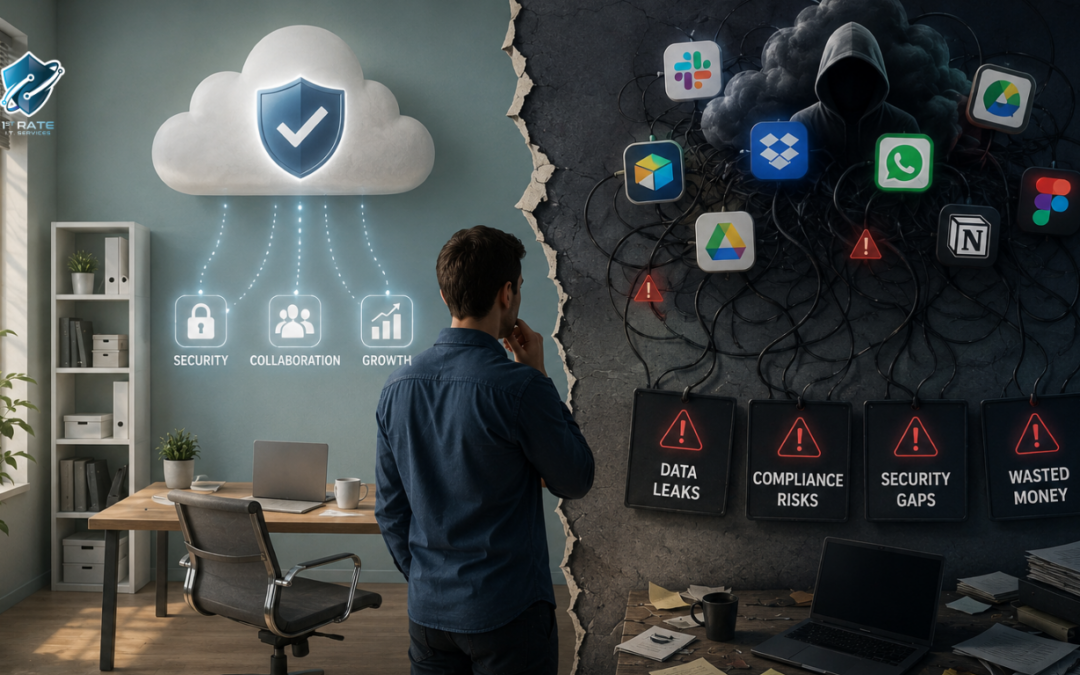
Your employees are productive, your business is running smoothly, and everything seems under control. But behind the scenes, something dangerous might be happening. Team members are quietly downloading personal cloud storage apps, using unapproved communication tools, and storing sensitive business data on platforms you’ve never heard of. Welcome to the world of Shadow IT—and it’s costing small businesses more than they realize.
What Is Shadow IT?
Shadow IT refers to technology systems, devices, and applications used within your organization without explicit IT approval or knowledge. Your marketing team might be using a personal Dropbox account to share files. Your sales department could be leveraging an unauthorized project management tool. Customer support might be relying on a free video conferencing platform instead of your approved system. While these choices often come from good intentions—employees want efficiency—they create serious vulnerabilities.
The Hidden Costs of Shadow IT
Security Breaches and Data Loss
When employees use unauthorized applications, your data leaves your control. Unlike enterprise-grade platforms, many free or low-cost tools lack robust security features. If a breach occurs on one of these platforms, your sensitive business information—customer data, financial records, proprietary information—is exposed. Recovery costs are astronomical, and the damage to your reputation can be irreversible.
Compliance and Legal Problems
Depending on your industry, regulations like HIPAA, GDPR, or PCI-DSS require that all customer and business data be stored and managed on approved, secure systems. Shadow IT violations can result in significant fines and legal liability. A small business that can’t afford compliance penalties can face existential threats.
Integration and Productivity Losses
When data lives in multiple unsanctioned platforms, it becomes impossible to get a complete picture of your business. Your accounting system can’t reconcile data from unauthorized spending apps. Your analytics tools can’t consolidate information from rogue databases. Employees waste time manually transferring data between systems instead of doing their actual jobs.
Licensing and Financial Waste
You might be paying for enterprise software licenses while employees bypass them with cheaper alternatives. Meanwhile, you’re also paying for their unauthorized tools subscriptions. This duplication of spending drains your IT budget while providing worse security and less integration.
How to Combat Shadow IT
Start With Conversation, Not Punishment
Ask employees why they’re using these tools. Usually, it’s because approved systems don’t meet their specific needs or they’re unaware of better options. Understanding their pain points helps you address the root cause.
Approve and Integrate Legitimate Tools
If an unauthorized tool solves a genuine business problem, evaluate it properly. Consider security, compliance, cost, and integration capabilities. You might be surprised that the tool your team loves is worth officially adopting.
Simplify Access to Approved Platforms
Ensure your official systems are user-friendly and accessible. If they’re clunky or slow, employees will find workarounds. Invest in platforms that integrate well and actually solve problems.
Educate Your Team
Help employees understand why security policies exist. When they see the real consequences of data breaches, most people become advocates for proper practices.
Monitor Without Micromanaging
Use network monitoring tools to identify unauthorized applications. This isn’t about distrust—it’s about protecting your business and your employees’ work.
The Bottom Line
Shadow IT isn’t about rogue employees. It’s a symptom of unmet needs, poor communication, or overly restrictive systems. Small businesses can’t afford the consequences of data breaches, compliance violations, and operational inefficiencies.
Partner with IT professionals who understand your business to build a technology environment that’s both secure and practical—contact 1st Rate I.T. Services for a security assessment today.