
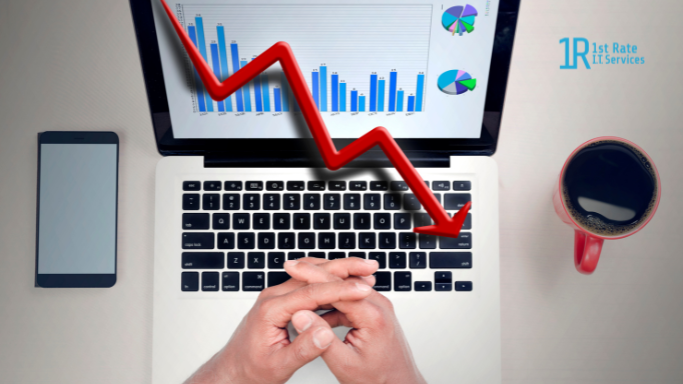
Picture this: your sales system crashes in the middle of a busy Monday morning. Your employees can’t process transactions, customers can’t access their accounts, and the phones start ringing off the hook. Every minute your business stays offline means lost sales, frustrated clients, and mounting costs.
Now multiply that by an hour—or worse, a full day.
According to Gartner, the average cost of IT downtime is $5,600 per minute, which equals over $300,000 per hour for mid-sized companies. For smaller businesses, that number may be lower—but the damage is often harder to absorb. Downtime doesn’t just hurt your systems; it impacts your entire business ecosystem.
1. The True Cost of Downtime (It’s More Than Just Lost Sales)
Many organizations underestimate the financial and operational impact of downtime. It’s not just about the inability to work—it’s about everything that stops working around it.
Here’s what downtime really costs your business:
- Lost Productivity: Employees sit idle waiting for systems to come back online. If ten employees earning $30/hour are down for half a day, that’s $1,200 in wages with zero output.
- Lost Revenue Opportunities: Missed transactions, dropped calls, or delayed projects all hit your bottom line directly.
- Reputational Damage: Clients and partners lose confidence when your systems appear unreliable. A single bad experience can cost you repeat business.
- Emergency Repairs: Without preventive IT support, every issue becomes an emergency — and emergency fixes come at a premium.
A 2024 study by Aberdeen Group found that unplanned downtime cost small and midsize businesses an average of $140,000 per incident, with recovery taking anywhere from four hours to three days.
2. The Hidden Risks Behind Downtime
Downtime doesn’t just happen—it’s often the result of preventable issues.
Here are the most common culprits we see at 1st Rate I.T. Services:
- Outdated Software & Hardware: Aging equipment leads to unexpected crashes.
- Weak Network Infrastructure: Poor configuration or unmanaged routers cause bottlenecks.
- Cybersecurity Threats: Malware or ransomware infections can cripple entire systems.
- Human Error: Accidental deletions or misconfigurations are a leading cause of downtime.
- No Backup or Redundancy Plan: When data or systems fail, there’s no quick way to recover.
Most of these problems can be avoided through proactive IT management — but only if your systems are being monitored, patched, and protected 24/7.
3. Why Proactive IT Support Is a Profit Strategy
Here’s the truth: downtime prevention is not an expense; it’s an investment in profitability.
When your IT is managed proactively, you’re not just fixing problems — you’re preventing them entirely. This model is called Managed IT Services, and it focuses on anticipating issues before they cost you money.
With proactive IT management, your business benefits from:
- Continuous Monitoring: Your systems are watched 24/7 for signs of trouble.
- Scheduled Maintenance: Software patches and hardware updates happen regularly — not reactively.
- Data Backups & Redundancy: Automated backups ensure your data is never lost.
- Predictive Analytics: Potential failures are caught early through data insights.
- Cybersecurity Integration: Firewalls, antivirus, and endpoint protection are always up to date.
Businesses that adopt proactive IT management reduce downtime by up to 85%, according to a 2024 CompTIA report.
4. Real-World Impact: A Case Example
Let’s say a local accounting firm experiences a sudden server crash during tax season. Without a managed IT plan, their team loses access to critical client files and can’t process returns for two days.
The result?
- 48 hours of lost productivity
- $12,000 in direct labor costs
- 3 missed client deadlines
- Long-term reputational damage
Now compare that to a firm under 1st Rate I.T. Services’ Managed IT plan. Their network is backed up nightly, monitored for irregularities, and equipped with remote recovery tools. In this scenario, downtime lasts just 20 minutes — with zero data loss.
That difference is the value of prevention over reaction.
5. IT Support as a Strategic Business Partner
Reliable IT isn’t just a safety measure — it’s a growth enabler.
When your technology runs smoothly, your team can focus on what matters: serving clients, closing deals, and scaling operations.
A true IT partner doesn’t just fix things when they break; they help you:
- Identify inefficiencies in your workflow.
- Integrate automation for repetitive tasks.
- Migrate to cloud solutions that support scalability.
- Implement cybersecurity compliance to protect client trust.
- Plan long-term tech investments aligned with your goals.
At 1st Rate I.T. Services, we position ourselves as an extension of your team — not just your IT vendor.
6. The Future of Business Reliability
In 2025 and beyond, businesses that thrive will be those that can stay online, stay secure, and stay scalable — no matter what the digital landscape throws at them.
Unplanned downtime isn’t inevitable; it’s a choice between being proactive or reactive. The companies that treat IT as a core business strategy, not a side expense, are the ones that stay ahead.
Conclusion
Every minute counts when your business depends on technology. Downtime doesn’t just disrupt—it costs you revenue, credibility, and peace of mind.
Partnering with 1st Rate I.T. Services gives you more than IT support; it gives you business continuity — a seamless safety net designed to keep your operations running, your data protected, and your clients confident.
Let’s make your business resilient, reliable, and ready for growth.
Contact 1st Rate I.T. Services today for a complimentary systems assessment and discover how proactive IT support can protect your bottom line.